
Dive Trips · Playas del Coco
Scuba Diving the Catalina Islands
A fast boat ride south of Coco Beach, the Catalina Islands are your best shot at the Pacific Giant Manta — plus rays, turtles, sharks and huge schools of fish, year round.
Catalina Islands, Costa Rica
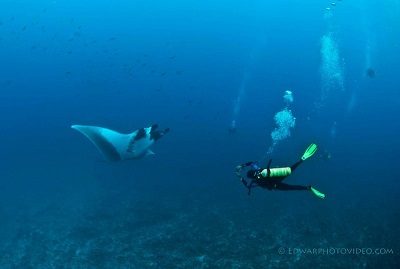
The Catalina Islands are some of the best spots to scuba dive in all of Costa Rica. There are several dive sites located around these islands, which protrude from the Pacific in the Guanacaste Province of Costa Rica. The islands are a fair distance offshore and are home to the Pacific Giant Mantas, among other marine life.
If you are visiting Costa Rica with the intention of scuba diving, you will not want to skip the Catalina Islands. In addition to the Pacific Giant Mantas, we also frequently see sharks, turtles, eels, and huge schools of fish.
With the distance you must travel to visit the Catalinas, there is no better dive company to take you there than ours. Our boats are the fastest in the industry — twin 250-horsepower Yamaha 4-stroke engines will have you to the islands and back in about half the time of any other dive shop in the Coco Beach or Playa Ocotal region of Costa Rica.
Our dive shop also dives the Catalina Islands year round, meaning there is never a down time. If you are a diving enthusiast, you owe it to yourself to experience these dive sites in addition to our local dive sites.
Diving the Catalina Islands
The Catalina Island chain is an archipelago of rocky islets found 2–15 miles off the northwest coast of Costa Rica. The islands themselves are completely uninhabited, and their location, the currents, and their formation make them perfect places for large quantities of marine life to gather.
Visibility in the Catalinas is similar to that of other areas in the Guanacaste region. Divers will notice that conditions change frequently and without warning. Water temperatures are usually coldest during the dry season (January and February) and warmer in the rainy season. Visibility can range between 15 and 80 feet. The currents also fluctuate with the dive site, the tides, the season and the winds. Occasional strong currents are found, but our experienced divemasters — who have been diving the Catalinas for years — can usually plan to minimize the effect these currents will have on your dives.
Catalinas dive site map

What to consider when diving the Catalinas
While it's easy to find a dive shop that will dive the Catalinas, we feel strongly that we offer the best possible experience. We have experienced divemasters who navigate the waters and point out all of the marine life to you, and a boat captain who not only knows the water from above but has also worked as a divemaster. Knowing the dive sites, and which will be best on any given day, is something that only comes with experience.
In addition, our boat is the best in the Guanacaste region of Costa Rica — a purpose-built dive vessel that gets you there and back quickly and safely. We will work with you to pick you up from your hotels in the Playa Hermosa, Coco Beach, or Playa Ocotal regions of Guanacaste.
Marine life you'll encounter in the Catalinas
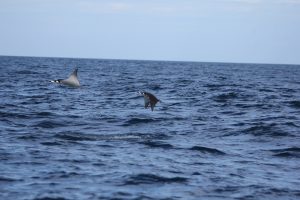
The marine life you'll encounter on your trip to the Catalinas is nothing short of amazing. There are, of course, the Pacific Giant Manta Rays, found at several of the dive sites. The area is also well known for schools of devil rays, spotted eagle rays, bullseye rays, bat rays, mobula rays and various other stingrays. There are huge schools of tropical fish ranging in size from micro to massive, and quite often sharks (most commonly the white-tip reef shark) and several varieties of eels.
Located not too far off famous Playa Grande, it's also not uncommon to see several species of turtle swimming about the islands. Less common, but possible, are whale sharks, tiger sharks, humpback whales, and in a few instances even orcas have been spotted in these waters.
During your surface intervals you'll be amazed by the devil rays that use the waters around the Catalinas as a playground — launching and flipping several feet out of the water and coming down with a splash. It's thought they do this to knock parasites off their skin.
Catalinas dive sites
Diving with big animals is your thing? Take a look at our trips to the Bat Islands.
Ready to make some bubbles?
Give us your dates and we'll get you out to the Catalinas on the next good day — mantas willing. Fruit, snacks and a fast boat are on us.
Book your Catalinas dive with Rocket Frog Divers →